The Lady Who Said No To The Duke
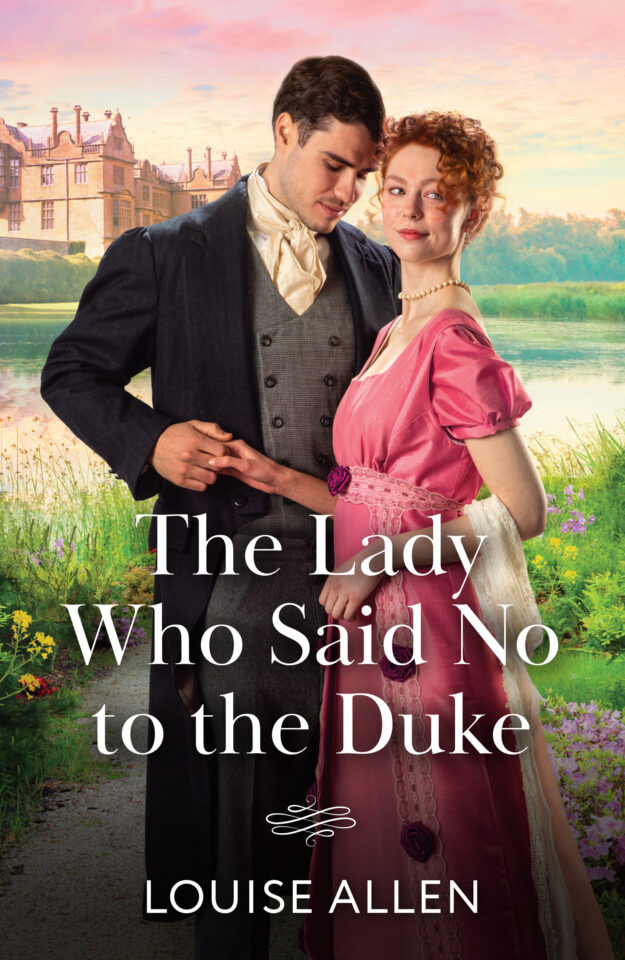
No young lady says “No” to a proposal from a duke, surely?
Lady Thea Campion was not going to agree to an arranged marriage to a man who she hasn’t seen since childhood – when he had managed to comprehensively insult her – even if he was a duke.
If the Duke of Leamington wanted her, then he could bestir himself to actually propose and until he did, then she was going to stay with her godmother. It was a good decision because there she met Mr Hal Forrest and found a friend, full of good advice on dealing with the Duke.
If only it proved as straightforward as Hal made it seem…
Thea was about to discover that turning down a duke was not as simple as she had hoped.
Excerpt
1st October 1815
‘No,’ Lady Thea Campion said. ‘Absolutely, definitely, no. I will not marry the Duke of Leamington.’
Her parents regarded her with blank astonishment written all over their usually impassive faces.
‘Foolish girl,’ her mother said, producing a faint laugh as though humouring a stubborn child. ‘This is no time for funning. You know perfectly well that you have been betrothed to Avery Vernier since you were in the cradle.’
‘I know no such thing,’ Thea retorted. ‘It was a family joke, the kind of thing the old aunts chuckle about – “Dear child, won’t she make a wonderful duchess.” I cannot be betrothed to him, I do not know him.’
‘You have met, surely you remember,’ her mother said. There was no amusement in her voice now.
‘When I was, how old? Ten? Yes, I remember him – a nasty bullying lout of a boy, all ears and big feet and big opinions of himself to match. I did not like him then. I do not know him now.’
He called me Twig.
That had rankled ever since. Yes, she had been a tall, skinny child, all angles and elbows, topped with a mop of red hair that had now matured into the much-admired colour of well-polished mahogany.
But that horrible boy had said she looked like a twig with one autumn leaf left on the end of it. I’ll call you Twig, he’d said with a laugh that cracked in the middle because his voice had not yet finished breaking.
‘But surely you understood,’ her mother tried again.
Her father simply looked thunderous. Earls were not used to being thwarted and certainly not by their daughters. Daughters were raised to be dutiful.
‘It was agreed between us and the late Duke and Duchess soon after you were born,’ Mama said. ‘It was spoken of as you were growing up, I am sure of it,’ she added vaguely.
‘Yes, as a joke. Why did I have a Season if you had already as good as married me off? Why are we making plans for my second Season now?’
‘Naturally you had to learn how to get along in society, to acquire some town bronze. His Grace could hardly marry a girl straight out of the schoolroom. And your first Season was delayed because of dear Mama’s death and then you had measles.’ She broke off as if to contemplate the wilfulness of her daughter in catching such a juvenile complaint. ‘So naturally it is important that you have as much exposure to good company as possible.’
‘I fail to understand what this is about.’ Her father finally spoke. ‘You sent all those young men along to me to have their suits refused without giving them any encouragement – and there must have been at least six of them. Why was that if you did not already know yourself to be promised, eh?’
‘Because I did not want to encourage any of them. I did not want to marry any of them. They were perfectly pleasant young men, but that was all. But they were persistent, so I told each of them to apply to you.’
Thea stared at her parents in exasperation. This was so typical of them. They never expected to have to explain anything to anyone and their word was law in the household.
Their children, of whom Thea, at just past twenty-one, was the eldest, spent a decorous half hour with their parents every day before dinner when they were growing up, attended church with them twice on Sundays and were occasionally summoned for disciplinary interviews when they transgressed. Then, when they reached an age when they could be trusted to behave with decorum, they dined with them with all due formality.
Exchanges consisted of social conversation or directives. Questions and opinions were not encouraged. This, Thea knew from exchanges with her friends, was perfectly normal in aristocratic households and she did not expect anything else. But not to have informed her that she had been betrothed for all of her twenty-one years, to have just assumed that she had absorbed the fact as anything but a family joke…
For a moment Thea was speechless, then she told herself that, unless she resisted, she would simply be swept along on the relentless tide of her parents’ will.

