Hauntings at the Black Cat Inn
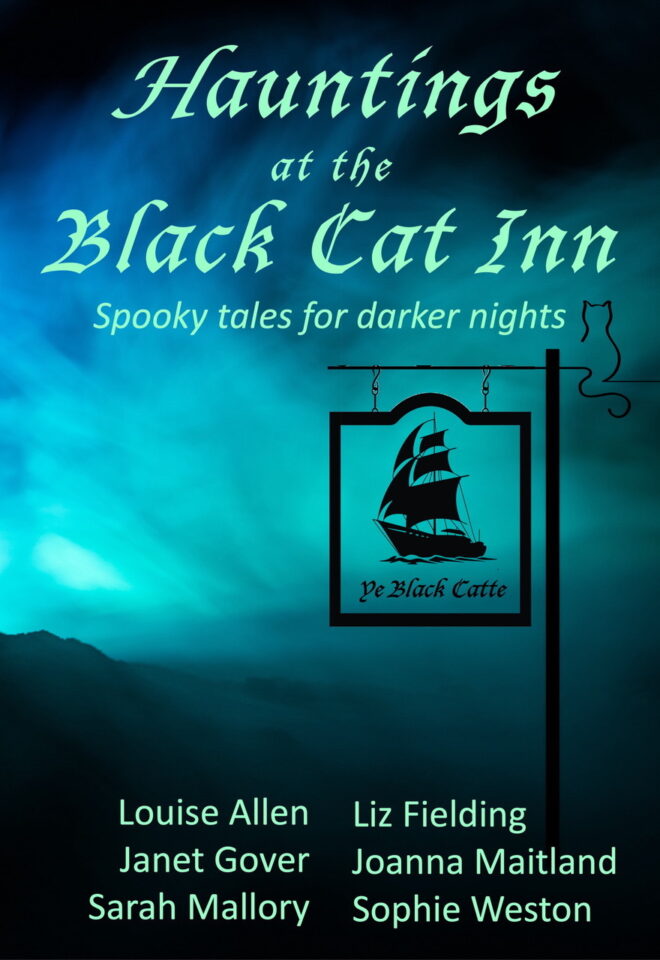
The Black Cat Inn, looming over the wild Cornish coast, is notorious for weird and spooky happenings. Yet, over the centuries, many famous travellers have found themselves there by strange twists of fate. You, too, are welcome to enjoy the inn’s renowned hospitality but, while you do, try to ignore the sounds of its lost souls. Who knows the truth of them? Perhaps only a ghostly feline presence…
Here are six spooky stories set over six centuries and featuring visitors to the Black Cat Inn. Meet a survivor of the Spanish Armada, Samuel Pepys, a Georgian veiled lady, a reluctant participant in a Victorian seance, Agatha Christie and an Australian in search of her past.
Each has been written by a different author – myself, Liz Fielding, Janet Gover, Joanna Maitland, Sarah Malory and Sophie Weston – bringing a range of styles and themes to the collection.
And there’s a cat. Or perhaps more than one…
Excerpt
The drizzle persisted all day, giving them no trouble at first, but after a few hours everything was soaked, despite the oiled woollen capes that Samuel Pepys and his clerk Hodge wore over their coats.
Hats dripped fore and aft and Samuel was thankful that he had removed the plumes from his and packed them away carefully. He should have removed his periwig as well, he thought ruefully as it swung sodden against his cheeks, like the ears of one of the King’s spaniels after they had been in the river. At least it was only his third best.
His nose was cold and he hoped it was not as red as Hodge’s. The man had his own hair and a broader-brimmed hat, which Samuel envied, under which his sharp features could be seen, set in misery. Samuel was not going to indulge him by explaining again why this ride was necessary. He had done so once, but Hodge was prone to sulking. It was his only fault, Samuel had to concede.
The Navy needed good small boats to work with the fleet in the wars against the Dutch Republic and Samuel, in his role as Secretary to the Lord High Admiral, had a duty to make certain that what they had were the best available. Word had reached London of a West Country boat builder with a craft that was both easier to row and to handle under sail with a few men, but was robust enough for service with the fleet.
The problem was to secure his design before the Dutch got wind of it and stole either the plans, or the boat builder. The French, in Samuel’s opinion the natural enemy of England, should also be thwarted in any attempt to improve their shipping, although the two countries were at uneasy peace now.
Thinking of the French brought Elizabeth to mind, which was not a comfortable thought at the moment. But, being from a Huguenot refugee family, at least his wife’s loyalty to England was never in doubt.
Marriage also complicated the matter in hand, as the boat builder, a Master Henry Carne, had a half-Dutch wife and that caused some concern at the Admiralty.
Carne, his entire family and boatyard must be investigated and he had to be persuaded to move to Chatham or Portsmouth and the shelter of the Royal Dockyards. Discreetly. Which was why Samuel could not simply sail into the tiny harbour of Trehallows and had landed at the larger port of Fowey to the east.
He and Hodge had viewed the defences at St Catherine’s and Polruan castles the day before, making no effort to hide what they were about, or their connection with the Admiralty. Then they had let it be known that they intended to view the neighbourhood for look-out points and possible sites for coastal batteries. That deception, at least, had Hodge’s approval: he was apt to see Dutch spies under every lobster pot or coil of tarred rope.
What the clerk did not approve of were long rides in the wet on tracks so frightful that the use of the word road was laughable and which made it very obvious why wheeled transport was scarce anywhere in the area. A pack horse followed stolidly behind Hodge’s own mount, one of the many available in Fowey to transport goods inland.
Pepys did not point out again that they had wasted a good hour at the start when Hodge misread his own notes, muddling east and west, and they had to retrace their earlier route. He had added to their woes himself by thinking he had discerned a short cut which proved only to lead to a deserted mine in a valley that was a dead end. That had lost them nigh on two hours.
Even Samuel’s usual enjoyment of riding had long since faded and he squinted through the swirling mist in an attempt to try and judge the time. It was approaching four of the clock, he estimated, realising that the drizzle had ceased and it was the clinging dampness of the sea fret that made them so chill and dripping wet.
Yet it was something more than the discomfort of the weather that made him shiver. He hoped he was not sickening and that his kidneys, always unreliable in dank weather, were not about to have another megrim.
Hodge took advantage of a slight widening in the path to bring his horse up alongside. ‘How much further, sir? I do not relish being out here after dark, and that’s the truth. And this mist is unnatural. They do say there’s all sorts of strangeness and ungodliness around here. Big black dogs that follow you, silent as death, with blood dripping from their fangs, waiting to pounce. Drowned sailors who rise up from the depths and come ashore in the fog to drag down others to share their doom. Mermaids singing from the rocks to lure you to your fate…’
‘Nonsense,’ Samuel said briskly, suppressing an immediate urge to turn in the saddle to check behind them. ‘A good churchman should not heed such superstitious nonsense.’
Hodge was not to be snubbed so easily. ‘And they did say last night in the tavern that there’s some place around here where this pair of hairy hands suddenly appear over yours, strong as iron, steering your horse towards the cliffs, or your boat onto the rocks.’
‘An excuse for bad riding or sailing when too much sack has been drunk.’ The only reason he was seized with sudden shivers was the cold and the damp, of course. But there was something particularly horrible about the idea of phantom hands on his, particularly hairy ones, for some reason.
‘Do not be so afeard, Hodge. It cannot be so much further to the inn.’
Provided we are finally on the right path.
The track was level now, passing over heathland with the drop to the sea on one side. A skeletal form loomed up suddenly out of the swirling whiteness.
‘By the–!’
Samuel’s mount jibbed at the violent tug on the reins.
‘Only a wind-blasted tree,’ he said, steadying his voice and hoping Hodge had not noticed his instinctive recoil. Those bare branches dwindling into twigs had seemed for a moment like the ghostly hands Hodge had spoken of. ‘At least we are in no danger of losing the direction of the cliffs, not with the gales from the sea tormenting those trees in such a way.’
‘How do we get down to the shore?’ Hodge was squinting at his notes, now smeared and damp.
‘We do not need to, not until tomorrow. Trehallows harbour is at the foot of one of these narrow valleys cutting down to the sea. But the inn is inland a little, on this level, so they told me. Clear of the shore and the dangers from the Barbary corsairs and their raids to seize cargoes and take slaves.’ That was another peril that the Navy had to deal with, even though the late Protector had cleared them from Lundy Island and the punishment of captured pirates was savage.
‘I will be glad to be back in London, that I will.’ Hodge dropped back, muttering to himself and, Samuel suspected, murmuring a few prayers against undead spirits and all-too-alive corsairs.
It was another twenty minutes or so before the track began to dip to cross a clapper-stone bridge over a narrow, rock-strewn stream. Another way led off down amongst the trees, vanishing into mist-laden gloom towards the sea.
‘There’s a finger post.’ Hodge rode up to it, rubbed away the growth of lichen and peered closely. ‘Tre – and then something that’s eaten by the rot. Ends in s, I think,’ he added doubtfully. ‘Everywhere around here is Tre something, if it isn’t Pol or Pen.’
‘It’s the right area,’ Samuel said, raising his voice to be heard over the noise of the little river beside them as it rushed down in a series of waterfalls. ‘The inn should be just up here.’ He urged his reluctant mount over the ancient bridge and peered ahead. ‘There’s a light.’
Another minute brought a rambling stone building into view, its silhouette breaking the skyline and merging into the granite outcrop from which it seemed to have grown. There was a lantern over the door and light from one of the long ground floor windows with its mullions and leaded panes. It seemed to be watching them though half-opened eyes.
‘It crouches there like a beast,’ Hodge muttered, coming up beside Samuel so quietly that he startled to hear his own thoughts echoed.
‘You would crouch low if you were on top of this cliff for all time, in all weathers,’ he retorted. One of them had to be down to earth and not give way to foolish imaginings. ‘It is ancient. And this is the right place.’
Fixed to the front was the inn sign, a black-sailed ship on a tempestuous sea and under it, in uneven script, The Black Catte.

